KOICA KOICA Grant Aid · Dominican Republic · 2026–2031

Strengthening Sargassum Monitoring and Management Capacity in the Dominican Republic

From satellite detection and drift forecasting to coastal containment, collection and treatment — building a Dominican-led system to reduce the damage caused by mass Sargassum influxes along the Caribbean coast.

2026 – 2031Project period (to 31 Dec 2031)
USD 5.11 MKOICA budget (KRW 7.05 bn)
4.47 MDirect beneficiaries in coastal districts
Boca ChicaPilot facility site · nationwide monitoring
Background

A seasonal nuisance has become a year-round coastal hazard

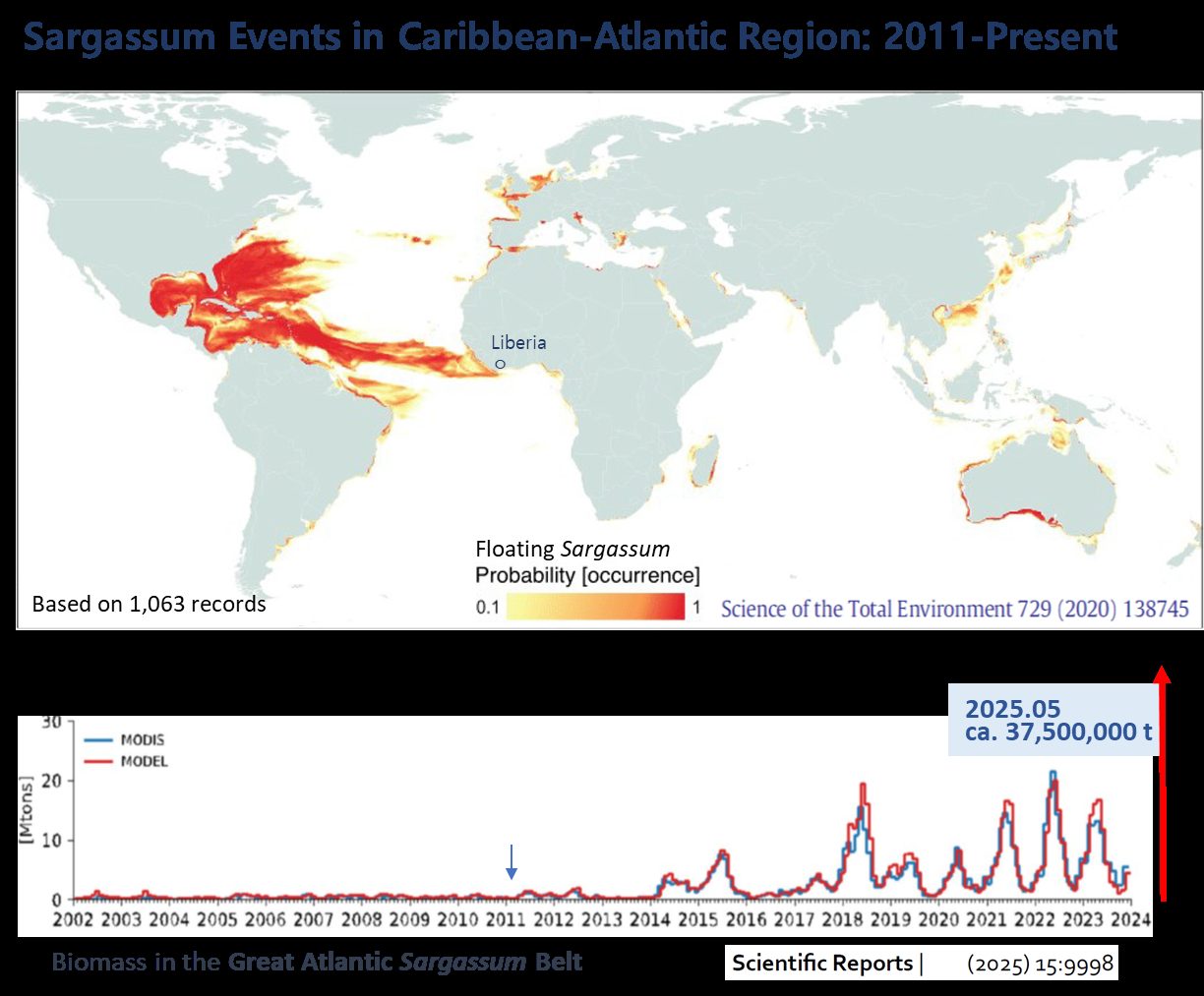
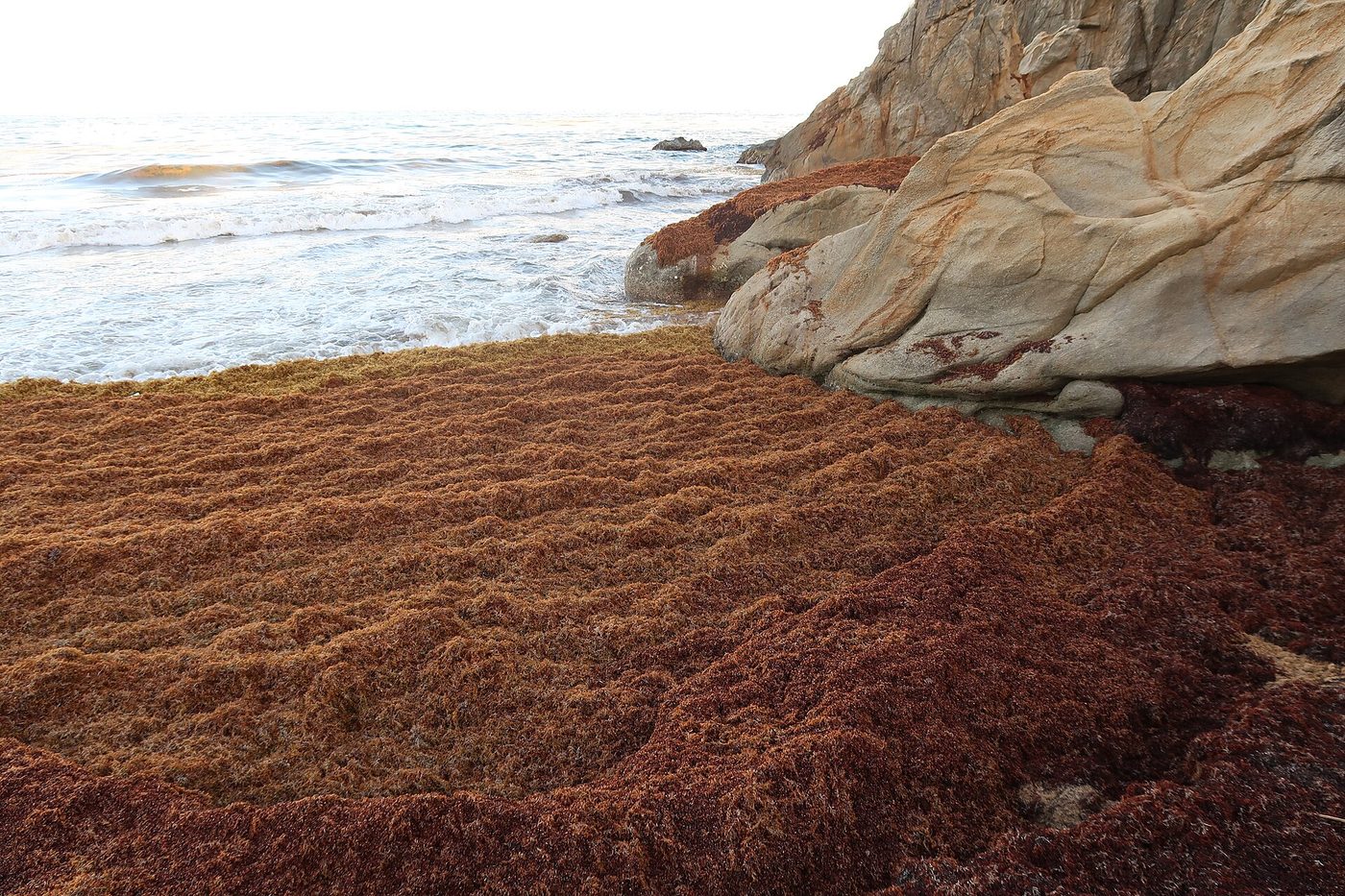
Since 2011 the Great Atlantic Sargassum Belt has stretched from West Africa to the Caribbean. Pelagic Sargassum that once stayed in the Sargasso Sea now arrives on Dominican beaches almost every month, with record biomass in 2025 and another near-record year in 2026.

The Great Atlantic Sargassum Belt

Satellite records show floating Sargassum biomass across the tropical Atlantic climbing from a few million tonnes in the early 2010s to roughly 37.5 million tonnes in May 2025, the highest ever observed. In June 2026 the Caribbean basin recorded its densest accumulation for that month, and total Atlantic biomass reached about 90 % of the 2025 record.

The Dominican Republic sits on the front line. Between 2015 and 2018 alone, influxes were documented at some 50 locations across 15 provinces — including Punta Cana, Bayahibe, Boca Chica and Juan Dolio — and the trend has been rising and lengthening ever since.

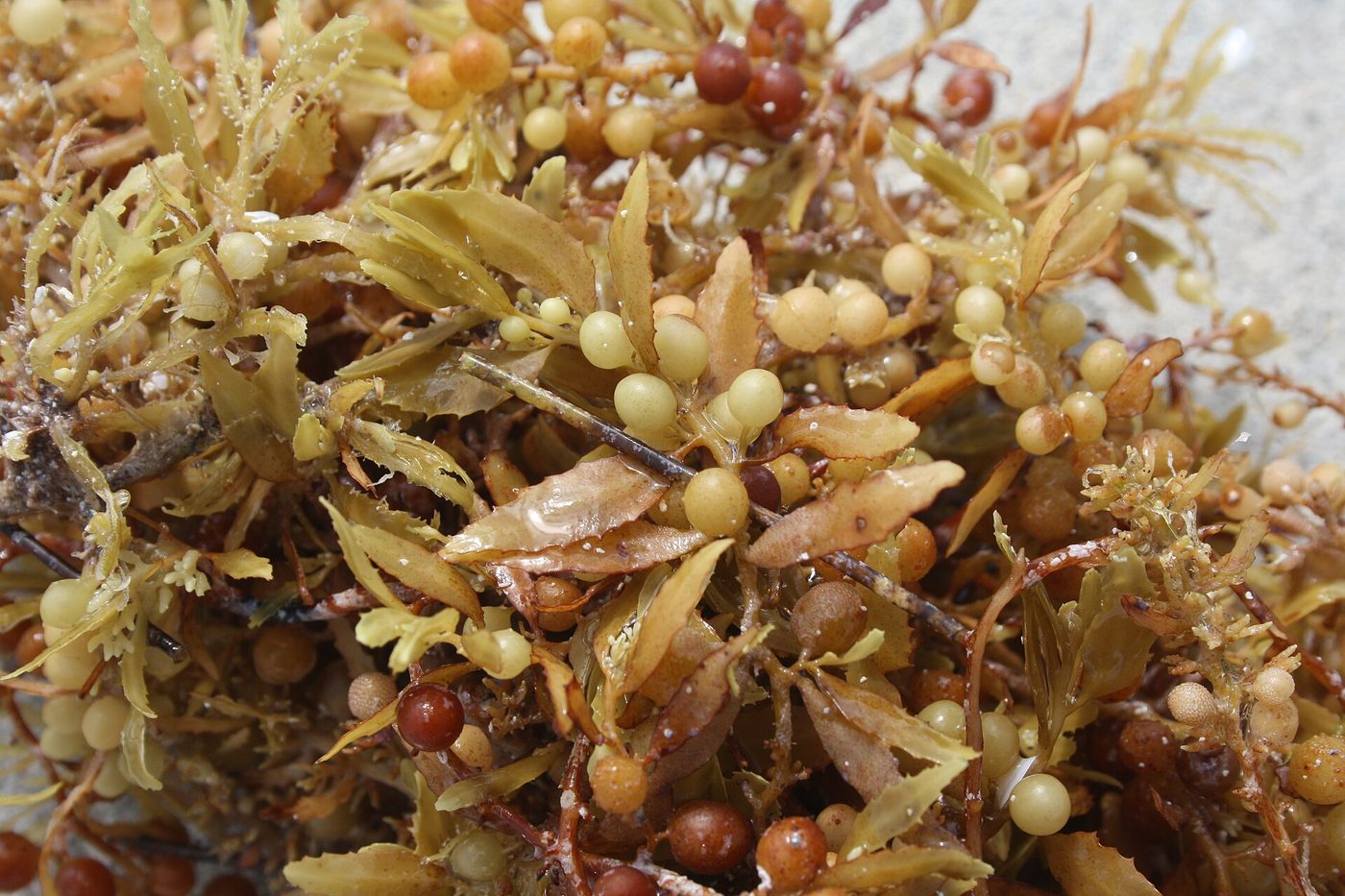
  • Origin: nutrient-rich outflow, ocean warming and shifting currents feed a recurrent belt of S. fluitans and S. natans.
  • Transport: trade winds and the Caribbean Current push mats west onto Atlantic-facing coasts of Hispaniola.
  • Seasonality: peaks typically from April to August, but arrivals are now recorded in every season.
Map of Sargassum event probability in the Caribbean-Atlantic region 2011–present and a time series of Great Atlantic Sargassum Belt biomass peaking at about 37.5 million tonnes in May 2025
Sargassum event probability 2011–present (Science of the Total Environment, 2020) and belt biomass 2002–2025 (Scientific Reports, 2025). From the consortium proposal.
🏝️TourismOdour, closed beaches, fewer arrivals
🐟FisheriesFouled gear, reduced catches
🩺Public healthHydrogen sulphide, arsenic content
🪸EcosystemsCoral, seagrass, turtle nesting
⚡InfrastructureCorrosion, cooling-water intakes

Where the Dominican Republic stands today — and where the project takes it

Fragmented governanceNo inter-agency framework or standard response guideline; data sits in separate ministries, the Navy, ANAMAR and private funds.
→
Integrated governance (Consulting)Cooperation framework centred on the Ministry of Environment (MMARN) and a national mass-influx response guideline.
Dependent monitoringReliance on subscribed foreign products and weekly bulletins; no domestic detection or forecast capacity.
→
Operational monitoring & forecast systemSatellite (optical + SAR), drone and mobile data fused into daily detection and 5-day drift forecasts, run by MMARN.
Neglected public beachesCollection concentrated at resorts; public beaches such as Boca Chica lack containment or treatment facilities.
→
Public pilot facility (Pilot project)Containment booms, collection equipment and a treatment line at Boca Chica public beach, with a community O&M model.
Weak utilisation baseHigh arsenic content and no research network limit safe valorisation of collected biomass.
→
International cooperation (Capacity building)Korea–Caribbean joint research, workshops and local training, shared across ACS member states.

Objectives

Reduce Sargassum damage by strengthening the Government's capacity to manage it

The project logic links four outputs — governance, monitoring, a pilot facility and international cooperation — into one detection → forecast → response → cooperation chain owned by Dominican institutions.

Goal long term · after 2031
Contribute to reducing the damage caused by mass Sargassum blooms in the Dominican Republic
Outcome medium term · 2029
Strengthened capacity of the Government of the Dominican Republic to manage Sargassum impacts
Outputs short term · 2027–2031
OUTPUT 1 · CONSULTINGStrengthened governance for integrated Sargassum management
OUTPUT 2 · MONITORING SYSTEMRemote-sensing-based Sargassum monitoring and forecast system in operational use
OUTPUT 3 · PILOT PROJECTSargassum containment, collection and treatment facility installed at a selected coastal site
OUTPUT 4 · CAPACITY BUILDINGInternational cooperation programme for Sargassum disaster response delivered
≥ 1 / dayDetection and forecast updates produced by the national system
Satellite · drone · mobile fusion, 5-day drift forecast
~600Officials, practitioners and stakeholders trained
Invitational training in Korea, local workshops, ACS regional session
7.95 MIndirect beneficiaries in coastal municipalities
4.47 M direct beneficiaries in coastal districts
Project components

Four components, one integrated response chain

The Project Management Consultant (PMC) consortium delivers the consulting, design, research and training work directly, and prepares and supervises the separate contracts for system development (PC1) and facility construction (PC2).

01
🏛️
Consulting · PMC

Governance for integrated Sargassum management

  • Inter-agency cooperation framework for producing and sharing monitoring information (BPR/ISP)
  • National response guideline for mass Sargassum influx — roles, alert levels, collection, transport and disposal SOPs (Korean & Spanish)
  • Invitational training in Korea for senior officials and practitioners
WITHUSKIOSTSusIF
02
🛰️
Monitoring system · PMC + PC1

Remote-sensing monitoring & forecast system

  • Improved detection algorithms: optical (Sentinel-2, Landsat) and all-weather SAR, multi-sensor fusion to beat cloud cover
  • Lagrangian particle-tracking drift model with up to 5-day arrival forecasts, validated against satellite maps
  • Monitoring & response system: dashboard, alerts, response records, mobile field reports; big-data cloud platform and equipment
  • API links to national emergency (COE) and existing platforms; smooth migration from subscribed services
KIOSTWITHUSPC1 · system developerAudit
03
🌊
Pilot project · PMC + PC2

Containment, collection & treatment facility at Boca Chica

  • Marine-environment survey and design adapted to Boca Chica's shallow (0.2–3 m) reef-protected lagoon
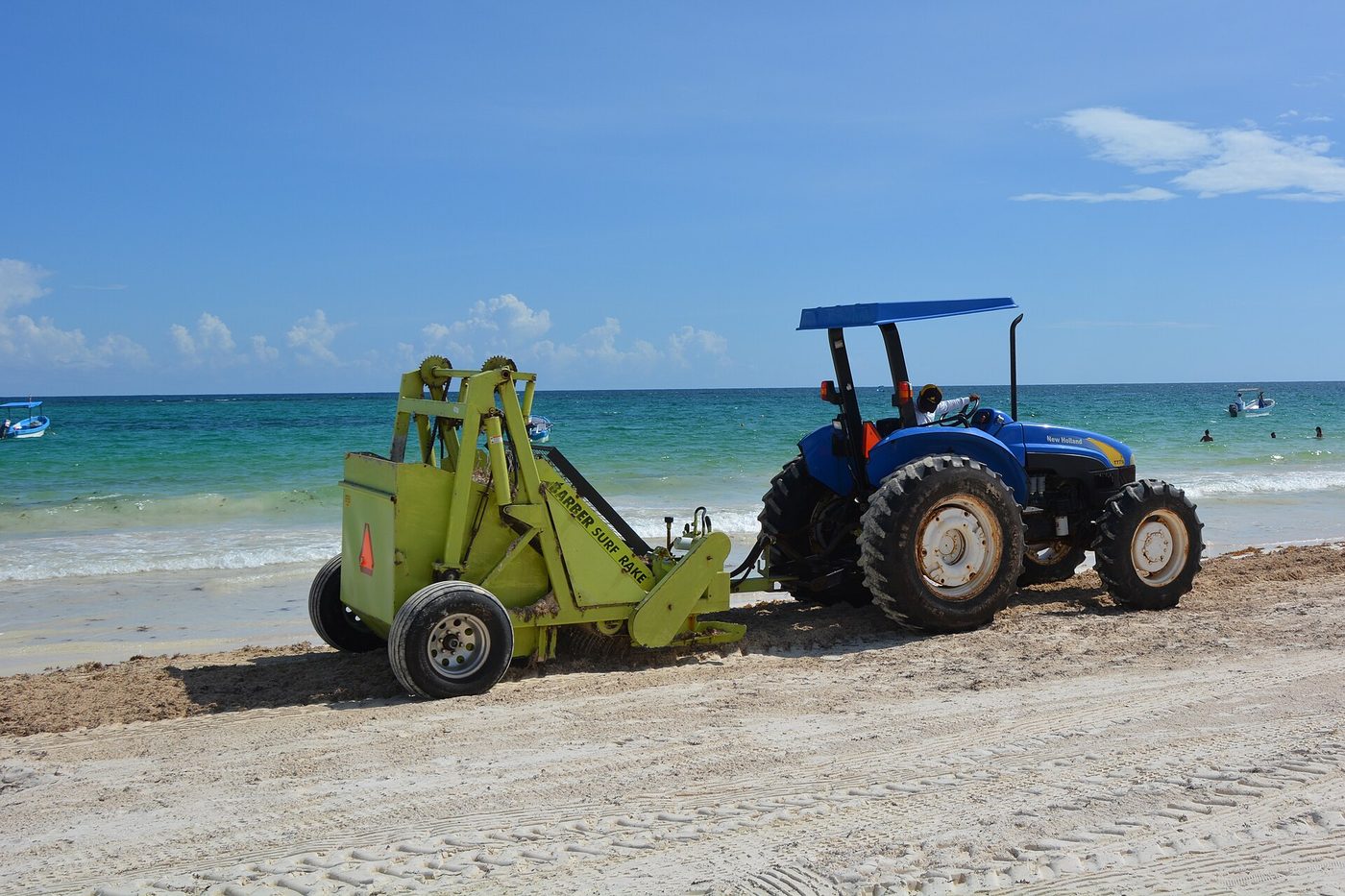
  • Two-tier collection: offshore booms at the reef line plus small-boat detachable harvesters inshore
  • Collection, dewatering and drying line; operation manual and maintenance training for local staff
  • Community-based O&M with the municipality, local NGO and beach vendors
KIOSTPC2 · fabrication & installation
04
🤝
Capacity building · PMC

International cooperation programme

  • Korea–Dominican joint research (2 topics, 3 years): arsenic removal and safe valorisation, ecosystem impact
  • International workshops and a Caribbean conference sharing results with ACS member states
  • Local training for tourism operators, circular-economy firms and coastal communities with NGO partners
KIOSTSusIF
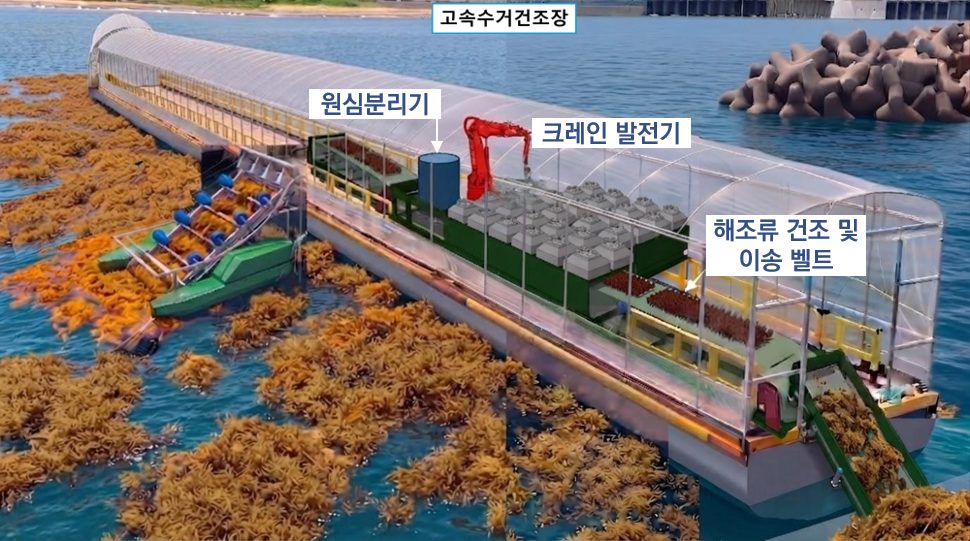
Concept rendering of a floating Sargassum harvesting and drying barge with centrifuge, crane and conveyor
Concept: floating collection–dewatering–drying line for the pilot facility. Consortium proposal, 2026.

Strategies tailored to Dominican conditions

1
MMARN-centred data framework

Unify data from the Presidency's Sargassum cabinet, ANAMAR, the Navy and the public–private Sargassum fund into MMARN's Integrated Sargassum Management Office.

2
Cloud-proof detection

Combine optical and SAR satellites with drone and mobile field data so daily products continue under Caribbean cloud cover.

3
Shallow-water two-tier collection

Booms at the reef edge and small-boat harvesters inshore, designed for Boca Chica's 20 cm–3 m depths and coral habitat.

4
Safe valorisation & regional reach

Address high arsenic content through joint R&D with INTEC, UASD and MESCYT, and share outcomes across the ACS region with IDB, FAO and SARG'COOP partners.

Indicative roadmap 2026 – 2031

Schedule is provisional and subject to agreement between KOICA and the Government of the Dominican Republic.

2026
  • PMC selection & contract
  • Kick-off, baseline survey
  • Stakeholder mapping
2027
  • BPR/ISP consulting
  • Response guideline drafting
  • Algorithm improvement starts
  • PC1 & audit RFP
  • Facility design
2028
  • Monitoring system development
  • PC2 selection, fabrication
  • 1st invitational training
  • Joint research
2029
  • System trial operation
  • Facility installation
  • Mid-line survey
  • International workshop
2030
  • Operational handover to MMARN
  • Facility O&M training
  • Local stakeholder training
  • Caribbean conference
2031
  • Guideline finalised
  • End-line survey
  • Final report & sustainability plan
Project organization

Who does what

KOICA and the Government of the Dominican Republic steer the project through a Joint Coordinating Committee; a Project Management Unit handles day-to-day coordination; the PMC consortium leads implementation together with separately contracted developers.

Decision-making
Joint Coordinating Committee (JCC)KOICA Caribbean Regional Office · Ministry of Environment and Natural Resources (MMARN) · Ministry of the Presidency (MINPRE) — management level
  • Reviews progress, takes major decisions, meets every six months
Management
Project Management Unit (PMU)KOICA Caribbean Regional Office · MMARN Vice-Ministry of Coastal and Marine Resources, Integrated Sargassum Management Office · PMC — working level
  • Working-level consultation, project support, progress reviews, monthly and ad-hoc reporting
Implementation
PMC — WITHUS · KIOST · SusIFOverall project management
  • Governance consulting (BPR/ISP, guideline)
  • Algorithm improvement, system planning & quality control
  • Pilot facility design
  • Capacity building & international cooperation
  • Performance management, PR
PC1 — System developerSelected via RFP prepared by PMC
  • Monitoring & response system development
  • Big-data cloud platform, servers and equipment
PC2 — Facility contractorSelected via RFP prepared by PMC
  • Fabrication and installation of containment, collection and treatment facility
  • Operation manual and O&M training
System auditIndependent auditor
  • Information-system and ICT audit of PC1 deliverables
Support
KOICA Dominican Republic Office
  • Overall project supervision, vehicle procurement, focal-point support
MMARN and related departmentsCoastal & Marine Resources · International Cooperation (Climate Change) · ICT
  • Focal points, administrative cooperation, operation and maintenance of the system and facility after handover
Beneficiaries
Direct — about 4,472,100 coastal-district residents and ~600 training participants
Indirect — about 7,953,502 residents of coastal municipalities
WITHUS Co., Ltd.
Lead firm · project management

WITHUS Co., Ltd.

Satellite ground-station and geospatial information systems company (Daejeon, est. 2023) with ODA experience in Indonesia and ISP consulting for Korea's national satellite centres.

  • Project Manager and overall PMC coordination
  • BPR/ISP consulting and inter-agency framework
  • Monitoring-system planning, PC1 RFP, IT infrastructure
  • Invitational training programme
KIOST — Korea Institute of Ocean Science and Technology
Ocean science & technology

KIOST

Korea Institute of Ocean Science & Technology — national research institute (est. 1973) operating the GOCI geostationary ocean-colour satellite ground segment, research vessels and a Caribbean research centre in Santa Marta, Colombia.

  • Detection and drift-forecast algorithms
  • National response guideline
  • Pilot facility design and marine-environment survey
  • Joint research, workshops, conference, international cooperation
SusIF — Sustainability Innovation Frontier
Sustainability & ODA consulting

SusIF Co., Ltd.

Sustainability consultancy (Seoul, est. 2022) specialised in environment, climate change and results-based management, with PMC experience in Central America and the Caribbean and Spanish-speaking staff.

  • Performance management (RBM, M&E, baseline/end-line surveys)
  • Central America–Caribbean ODA coordination
  • Local stakeholder training and NGO cooperation
  • Spanish-language coordination and translation
News & progress

Where the project stands

The project is in its procurement and mobilisation phase. Updates will be posted here as milestones are reached.

✓
RD signed2025
✓
PMC RFP issuedMay 2026
✓
Proposal submittedSep 2026
4
PMC contractQ4 2026 (planned)
5
Kick-offQ4 2026 – Q1 2027
6
Implementation2027 – 2031

WITHUS–KIOST–SusIF consortium completes technical proposal

The consortium finalised its PMC proposal, including a cloud-proof satellite–SAR–drone monitoring design, a two-tier collection concept for Boca Chica and a Korea–Caribbean joint-research programme.

Caribbean records densest June Sargassum accumulation on record

USF and NOAA satellite observations placed total Atlantic biomass at about 33.6 million tonnes, roughly 90 % of the 2025 record, signalling a severe influx year for Dominican coasts.

KOICA issues Request for Proposals for PMC services

KOICA's Central America & Caribbean Team published the RFP "PMC Service for the project Strengthening Sargassum Monitoring and Management Capacity in the Dominican Republic" (budget KRW 7,047,378,993 through 2031).

Record of Discussions signed between KOICA and the Dominican Republic

The Ministry of the Presidency and the Ministry of Environment and Natural Resources agreed with KOICA on the four-component project scope, the Boca Chica pilot site and a multi-year budget of USD 5.1 million.

PMC contract signature and kick-off report

Following evaluation, the PMC will mobilise in Santo Domingo, hold the kick-off meeting with the JCC and PMU, and launch the baseline survey and BPR/ISP consulting.

Sargassum monitoring · Dominican Republic

Coastal Sargassum status and outlook

Current beach status, seasonal index and estimated arrivals along the Dominican coast. Updated —. Forecast validity —.

NoneLowModerateHighVery high · Marker size grows with status

Beach status board

Sorted by severity · click a marker on the map for details

BeachStatusTrend

Seasonal Coastal Sargassum Index

Monthly index for the whole Dominican coast, 2024–2026 (0 = no influx, 100 = extreme)

Beaches by status

Share of monitored beaches in each status class

5-day arrival risk · Boca Chica

Drift-model risk for the pilot site (0–100)

Estimated beach arrivals by coastal sector

Thousand tonnes (wet weight) per year — Atlantic-facing east and south-east coasts receive the bulk of the influx

ℹ️
About these data. Status, index, arrival and forecast values on this page are illustrative sample values shaped after regional patterns published by the USF Optical Oceanography Lab and NOAA. They will be replaced by outputs of the national monitoring and forecast system developed under Output 2. Satellite detection is limited within about 1 km of the coast and under cloud cover; forecasts cover a 5-day horizon.
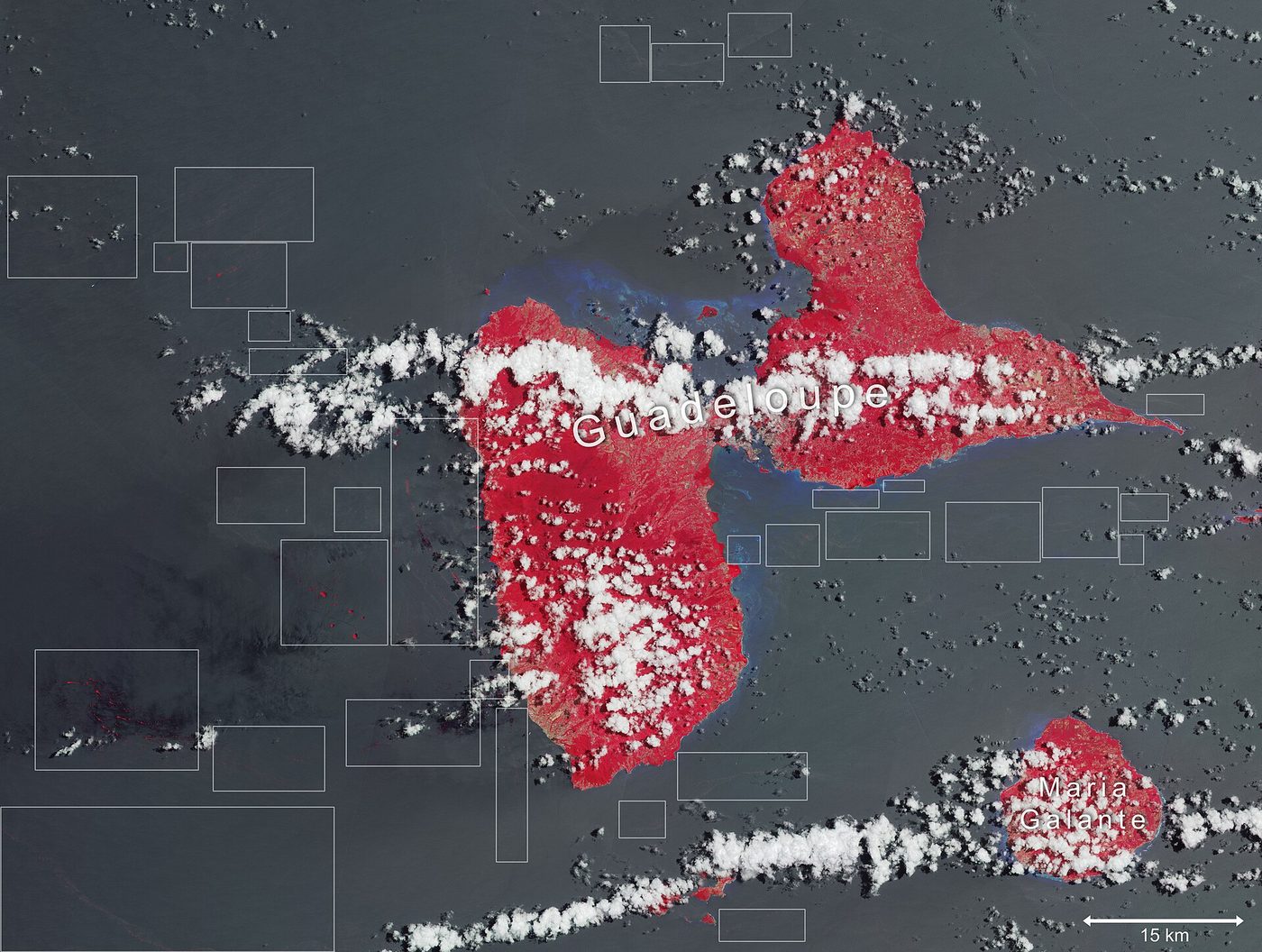
Copernicus Sentinel-2 satellite image with Sargassum detections highlighted around Guadeloupe
Copernicus Sentinel-2 detection of Sargassum around Guadeloupe — the kind of optical product the national system will produce daily for Dominican waters. Image: ESA (contains modified Copernicus Sentinel data), attribution.
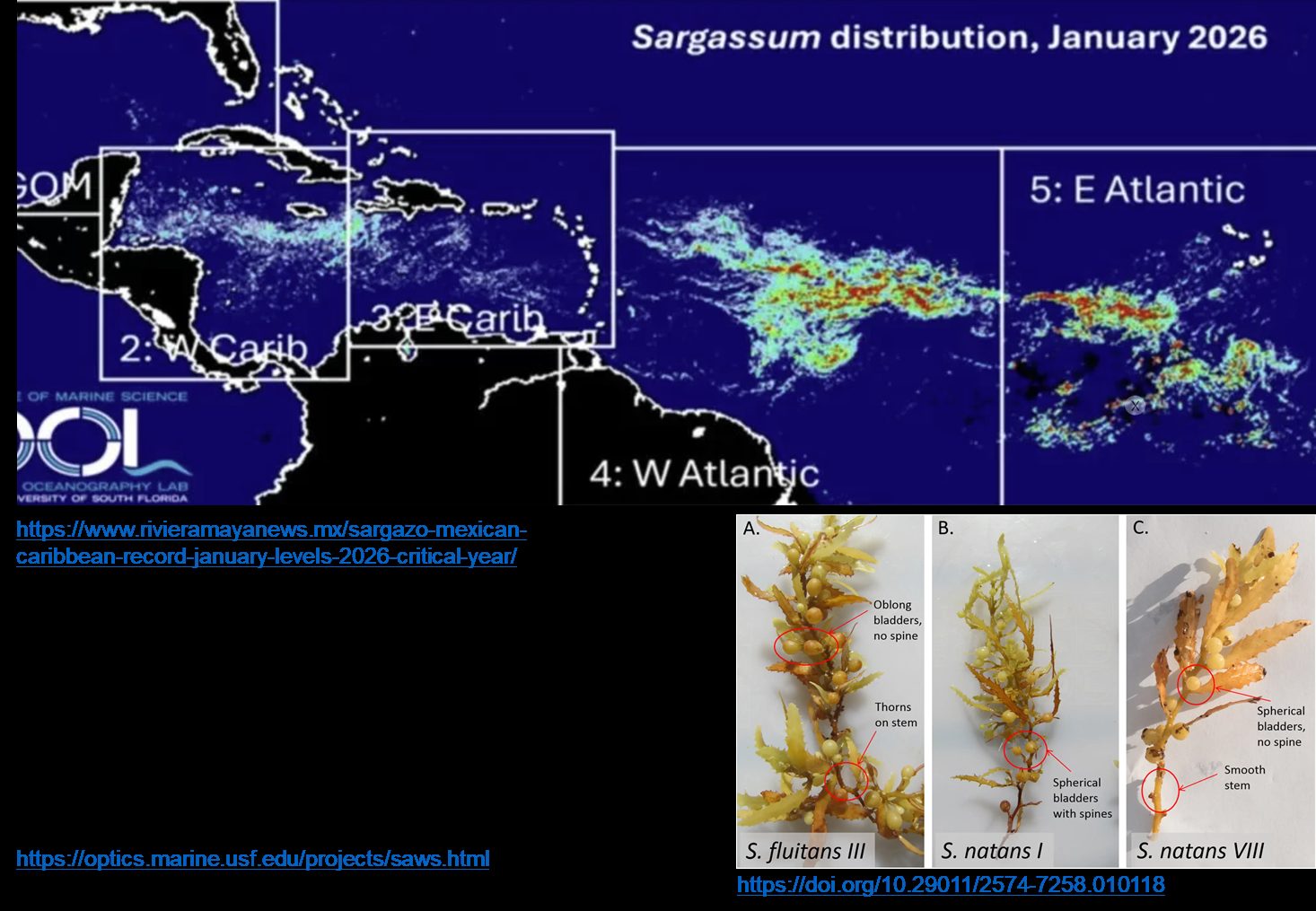
Satellite-derived Sargassum distribution map for the Caribbean and Atlantic, January 2026, with photographs of Sargassum fluitans and natans morphotypes
Sargassum distribution, January 2026 (USF Optical Oceanography Lab, Sargassum Watch System) and the three common morphotypes. From the consortium proposal.

Public data sources used for regional context

Partners

Funded by KOICA · implemented with Korean ocean-science and consulting expertise

KOICA — Korea International Cooperation AgencyFunding agency
WITHUSPMC lead · project management & ISP
KIOSTOcean science, algorithms, facility design
SusIFPerformance management & local capacity building

Partner country institutions: Ministry of the Presidency (MINPRE) · Ministry of Environment and Natural Resources (MMARN) · National Authority for Maritime Affairs (ANAMAR) · Municipality of Boca Chica

↑